

The rage economy: how outrage became the internet's most profitable business model
And how its working for & against India / Indians
The global attention economy has found its most reliable currency — and it isn’t creativity, truth, or value. It is anger. A convergence of algorithmic design, platform monetization structures, and the sheer scale of India’s 800-million-strong internet population has created an engagement ecosystem where outrage consistently outperforms every other form of content. This dynamic now shapes what billions of people see, feel, and believe every day, with measurable consequences for mental health, democratic discourse, and the integrity of online information. Oxford University Press named “rage bait” its 2025 Word of the Year — usage of the term tripled in a single year — signalling that what was once a fringe tactic has become the defining content strategy of the platform era.
Behind the headlines lies a precise economic logic. Platforms reward engagement volume, not quality. Negative emotional content generates 20–85% more engagement than neutral content across every major study. India, with the world’s largest audience on YouTube, Instagram, and Facebook — and with China’s 1.4 billion people walled off from Western platforms — has become the single most valuable engagement market on earth. The result is a two-sided exploitation machine: creators either flatter Indian audiences or deliberately provoke them, because both strategies produce the algorithmic fuel that drives visibility, followers, and revenue. This article maps the mechanics, economics, and geopolitical implications of this system — and asks what it will take to break the cycle.
Algorithms don’t optimize for truth — they optimize for reaction
The foundational problem is architectural. Every major social media platform ranks content using engagement signals — clicks, comments, shares, watch time, reactions — rather than chronological order or editorial judgment. This design choice, intended to maximize user retention, creates a structural bias toward emotionally provocative content.
The evidence base is now substantial. A landmark 2025 study published inScience by researchers Allen and Tucker conducted a 10-day field experiment with 1,256 participants on X during the 2024 U.S. presidential campaign. Using a browser extension that reranked users’ feeds in real time, they found that shifting exposure to hostile, antidemocratic content moved participants’ partisan animosity by more than 2 points on a 100-point feeling thermometer — providing causal evidence that algorithmic curation directly alters political attitudes. A parallel study by UC Berkeley researchers (Milli et al., 2025, PNAS Nexus) confirmed that X’s engagement-based algorithm amplifies emotionally charged, out-group hostile content compared to a reverse-chronological baseline — and critically, that users did not prefer the content the algorithm selected when asked to evaluate it directly.
The engagement premium for negative content is remarkably consistent across studies. William Brady’s analysis of 563,000 tweets found that each moral-emotional word in a political message increases its diffusion by approximately 20% — a finding replicated in 2025 across 849,000 additional tweets. Stanford’s Human-Centered AI Institute analyzed nearly 30 million posts from 180 news organizations and found that the most biased sources produced 12% more high-arousal negative content, which was the most likely to go viral. A Nature Scientific Reports analysis of 95,000 articles and 579 million social media posts showed users were 1.91 times more likely to share negative news. The MIT Media Lab’s foundational study of 126,000 news cascades confirmed that falsehoods — which disproportionately trigger outrage — were 70% more likely to be retweeted than truthful content and spread six times faster.
The most troubling finding comes from Yale. Brady, McLoughlin, Doan, and Crockett (2021, Science Advances) analyzed 12.7 million tweets from 7,331 users and demonstrated that people who received more likes and retweets for outrage expressions were more likely to express outrage in future posts — a textbook reinforcement learning dynamic. Politically moderate users were the most sensitive to these rewards, suggesting a mechanism through which platforms systematically radicalize centrists. As Molly Crockett put it: “Our data show that social media platforms do not merely reflect what is happening in society. Platforms create incentives that change how users react to political events over time.”
Platform design choices have been deliberately calibrated to exploit these dynamics. Internal documents leaked by Frances Haugen in 2021 revealed that Facebook weighted emoji reactions — including “angry” — at five times the value of a standard like beginning in 2017. Facebook’s own data scientists confirmed in 2019 that posts triggering angry reactions were disproportionately likely to contain misinformation and toxicity. Political parties in Poland reported their social media content shifted from 50% positive to 80% negative because engagement on constructive posts had collapsed. When Facebook eventually zeroed out the angry reaction’s algorithmic weight in September 2020, misinformation and violent content declined with no measurable drop in user engagement — proof that the outrage bias was a design choice, not a user preference.
From trolling to business model: the financial architecture of rage
Rage-baiting is not a behavioural aberration — it is an economically rational response to platform incentive structures. The creator economy, now valued at approximately $250 billion according to Goldman Sachs (March 2025) and projected to reach $480 billion by 2027, pays creators based on engagement metrics that do not distinguish between admiration and fury.
The mechanics vary by platform but share a common principle: attention is monetized regardless of sentiment. YouTube’s Partner Program, which has paid creators over $70 billion between 2021 and 2023, ties revenue to watch time and ad impressions. TikTok’s Creator Rewards Program, restructured in 2024, increased payouts 10–20 times over the previous Creator Fund, now paying $0.40–$1.00 per thousand qualified views — creating direct financial incentives for content that maximizes retention and comments. X’s ad revenue sharing program, launched in mid-2023, pays based on impressions from Premium subscribers who view ads in reply threads, meaning that long, heated argument chains beneath a controversial post are literally worth more than thoughtful discussions. The average payout on X is approximately $8.50 per million verified impressions, but political commentary creators with engaged audiences report earning $1,200 or more monthly.
Individual case studies illustrate the calculus. Influencer Winta Zesu publicly disclosed earning $150,000 in one year through deliberate rage-baiting — placing her in the top 4% of all global creators by income, far above the median creator who earns roughly $200 per month. “Every single video of mine that has gained millions and millions of views is because of hate comments,” she told BBC Marketplace. The strategy requires no production budget, no fact-checking, no expertise — only a willingness to provoke. As one industry analysis observed: “Trolling is a hobby; rage bait is a business model.”
The broader economic context amplifies these incentives. Forty-four percent of Americans now say they need a side hustle to survive financially (SurveyMonkey, 2025), with 61% reporting life would be unaffordable without supplemental income. Food prices have surged 30.7% since 2019. The global gig economy has grown to roughly $560 billion. Content creation offers a zero-barrier-to-entry income stream, and within that ecosystem, rage-bait represents the highest return on effort. Neutral, educational, or positive content requires research, skill, and production value. Rage-bait requires only a camera and a provocative opinion — and it generates three to ten times more engagement per post.
YouTube’s revenue data reveals a telling pattern: “betrayal and revenge narratives” — a genre closely adjacent to outrage content — generate the highest RPM (revenue per mille) at $12.82, exceeding even personal finance content in per-view creator earnings. This is because they combine long watch times with intense audience engagement, maximizing both ad load and algorithmic amplification. The economic logic is self-reinforcing: creators who discover that controversy pays migrate toward increasingly extreme content, while the vast majority of creators earning under $5,000 per year face mounting pressure to adopt the same tactics.
AI is accelerating the industrialization of this model. An estimated 71% of social media images are now AI-generated (2025 data), and 9 of the top 100 fastest-growing YouTube channels in mid-2025 relied entirely on AI-generated content. A 2025 paper by Rob Cover in New Media & Society documents the emergence of AI-generated rage bait, where no human actor is involved in creation or initial distribution. The production cost of outrage has effectively dropped to zero.
India’s 800 million: how the world’s largest audience became its most exploited
India’s position at the centre of the engagement economy is not incidental — it is structural, demographic, and irreversible. With 491 million YouTube users, 414 million Instagram users, and 384 million Facebook users as of January 2025, India is the single largest national audience on every major Western social media platform. On each of these platforms, India’s user base is approximately double that of the United States.
This dominance is the product of two converging forces. The first is what industry observers call the “Jio effect.” When Reliance Jio launched its 4G network in September 2016 with free data offers, it triggered a price war that crashed India’s mobile data costs by 95–98% — from approximately $3 per gigabyte to $0.09 per gigabyte, among the cheapest rates in the world. For context, the same gigabyte costs $6.00 in the United States and $7.29 in Switzerland. Prime Minister Modi has noted that 1GB of data in India now costs less than a cup of tea. The result was explosive: India’s internet user base more than doubled from 300 million to over 800 million in under a decade, average monthly smartphone data consumption surged from under 1GB to 32GB per user, and India became the world’s top mobile data consumer within six months of Jio’s launch. Rural India now has more internet users than urban India (488 million versus 397 million), and 56% of new users come from rural areas.
The second force is China’s absence. The Great Firewall blocks access to Facebook (since 2009), Instagram (since 2014), YouTube (since 2009), X/Twitter (since 2009), WhatsApp, and virtually every other Western platform. China’s 1.4 billion people operate within a parallel digital ecosystem — WeChat instead of WhatsApp, Weibo instead of Twitter, Douyin instead of TikTok, Bilibili instead of YouTube. With the world’s most populous nation entirely absent from Western platforms, India’s 1.46 billion people become the default largest audience by an enormous margin. No other country comes close.
India’s engagement intensity compounds the scale advantage. Despite having only 27.3 million users on X (ranking third behind the U.S. and Japan), Indian users generate 8.2% of global X content and retweet at 2.3 times the global average, producing 95 million tweets monthly. Indian users spend an average of 29 hours and 37 minutes per month on YouTube and over 20 hours each on Facebook and Instagram. Gen Z users in India average over three hours daily on social media — roughly 50% more than the global average. India’s social media user growth rate of 5.23% in 2025 outpaced a global decline of 0.81%, making it the fastest-growing major social media market. And with 652 million Indians still offline, the growth trajectory has years to run.
Yet there is a critical paradox embedded in these numbers. India’s digital advertising market, while growing rapidly at $13.6 billion in 2024 (projected to reach $32.3 billion by 2030), produces dramatically lower per-user revenue than Western markets. India’s YouTube CPM averages approximately $0.70 per thousand views — compared to $32.75 in the United States. As creator NAS Daily observed, the same number of followers in India generates roughly $100, while in the U.S. it generates $1,000. This CPM gap creates the foundational logic of India as an “engagement farm”: Indian views are individually cheap, but their sheer volume drives the algorithmic amplification that surfaces content to higher-value Western audiences.
The two playbooks: flattery and fury both feed the machine
Global content creators and brands have developed two diametrically opposed but equally calculated strategies for extracting engagement from India’s massive audience. Both exploit the same underlying dynamic — what Indian commentators have described as a collective desire for global validation in a nation still processing its rapid rise to economic and cultural prominence.
The flattery playbook is most visible in the reaction video industrial complex. Foreign YouTubers — primarily American, British, and Pakistani — discovered that reacting to Indian content triggers enormous viewership. The case of Our Stupid Reactions is instructive: two Los Angeles–based actors with 1,800 subscribers in January 2019 posted a reaction to the Gully Boy trailer at a subscriber’s request. The video exceeded 500,000 views. Within seven months, they had over 230,000 subscribers — 70% from India — and pivoted their entire channel to Indian content, monetizing through Patreon, ads, and brand deals. “Indians want the rest of the world to finally hear their voice and recognize them as world players at every level,” co-creator Rick Segall told BuzzFeed News. “It’s being affirmed by global superpowers.”
Jaby Koay, a California-based filmmaker, crossed one million subscribers reacting primarily to Bollywood content. His channel attracted attention from Dharma Productions, one of India’s largest film studios, which reposted his trailer reactions on their own Instagram — effectively providing free marketing to a foreign creator in exchange for the validation his reactions conferred. European football clubs have systematically adopted the same strategy: Manchester City, Arsenal, Barcelona, Chelsea, Liverpool, and PSG all produce Diwali and Holi greeting content specifically to engage India’s massive sports fanbase. NAS Daily (Nuseir Yassin) built India into his largest audience base, then launched a marketing agency in India in 2024 — his first market, before even Israel or the United States — with the Adani Group as its inaugural client.
The provocation playbook operates on the inverse principle: instead of earning engagement through praise, creators trigger it through insult — though the line between genuine opinion and deliberate bait is not always clear. Indian food has emerged as perhaps the single most reliable trigger for massive engagement. When Washington Post columnist Gene Weingarten wrote a column disparaging Indian cuisine, the resulting firestorm generated millions of engagements across platforms. When British lecturer Edward Anderson — who is married to a Malayali woman and has publicly expressed his love of Indian cuisine — replied to a Zomato poll asking users to name a dish they never understood by calling idli “boring,” the remark became national news in India within hours. Anderson later described it as his “dumb idli comment” and expressed surprise at the scale of the reaction — illustrating how even a casual food opinion, when it touches Indian cultural identity, can generate outsized engagement. Gordon Ramsay’s response to a Mumbai user’s photo of medu vada — a South Indian fritter — with a dismissive quip triggered widespread outrage, even though the user who sent the photo later said he had deliberately sought Ramsay’s trademark trolling. These episodes reveal a consistent pattern: whether the provocation is intentional or incidental, the algorithmic reward is identical.
The most insidious variant involves AI-generated fabrications. TikTok accounts like @indianstreetfoodonly (35,000+ followers) post AI-generated videos depicting fabricated, unsanitary Indian street food preparation, with titles like “Only in India” and “Would you eat this?” Individual videos have reached 40 million plays. As the Digital Forensics Research and Analysis Centre noted: “What begins as harmless ‘AI humour’ can quickly become a vehicle for stereotyping when it mocks specific communities.” The creator motivation is transparent — shocking content drives views, views drive revenue, and India’s enormous audience provides the volume.
The marketing calculus unifying both strategies is precise. A provocative post about India triggers millions of Indian users to comment and share. The algorithm interprets this engagement as a quality signal, surfacing the content to non-Indian users in higher-CPM markets — the U.S., UK, Australia, Germany. These Western impressions generate the actual advertising revenue. Meanwhile, the inflated follower counts and engagement metrics attract brand deals worth far more than ad revenue alone. As one analysis summarized: “Brands and influencers attract a crowd to their page, building trust through engagement and follower count. Then, they promote products to this audience, who are more likely to pay — often not Indians.” India provides the algorithmic fuel; Western audiences provide the revenue. The content itself — whether flattering or offensive — is merely the catalyst.
The feedback loop nobody is breaking
This system produces a self-reinforcing cycle with escalating consequences. A creator discovers that India-related content generates outsized engagement. Revenue and followers increase. The creator doubles down. Copycats emerge, forming entire sub-genres — reaction channels, food controversy accounts, nationalist commentary. Audiences on both sides calcify: Indian users come to expect either flattery or provocation from foreign creators, and foreign creators learn that moderation and nuance are algorithmically invisible. As engagement becomes harder to sustain, creators must escalate — more effusive praise, more offensive provocations — to maintain the same algorithmic reward. The content degrades. The outrage intensifies. The platforms profit.
McKinsey’s 2025 “Attention Equation” framework helps explain why this cycle is so durable. Their survey of 7,000 consumers found that a 10% increase in average focus is associated with a 17% increase in consumer spending — but outrage content captures attention through arousal, not focus. The distinction matters: rage-bait generates high volume, low quality attention. It inflates platform metrics without delivering the focused engagement that actually drives consumer value. Yet platforms continue to optimize for volume because their advertising models reward impressions, not outcomes.
The societal costs are mounting. The Yale reinforcement learning studies show that platforms are literally teaching users to be angrier through reward mechanisms identical to those used in behavioural conditioning. McLoughlin, Brady et al. (2024, Science) demonstrated across eight studies that misinformation sources evoke more outrage than trustworthy sources, and that outraged users are more willing to share misinformation without reading it first. Screen-based attention spans have declined from 2.5 minutes in 2004 to 47 seconds today (Dr. Gloria Mark’s research). Affective polarization in the United States has nearly doubled since the mid-1990s, with acceleration correlating to the algorithmic feed era. As venture capitalist and NYU professor Scott Galloway observed: “What the algorithms figured out is there’s something better than sex — and that’s rage. Enragement equals engagement, equals more ads, equals more shareholder value.”
For India specifically, the implications extend beyond individual mental health to national identity. The flattery-or-fury dynamic commodifies Indian cultural pride, transforming genuine national achievements into engagement fuel and legitimate cultural sensitivity into a predictable trigger mechanism. Indian commentators have noted the irony with increasing sharpness. “We as a nation are still insecure about our own culture, heritage, and lifestyle,” wrote one critic. “So insecure, in fact, that a comment that could easily be ignored became national news in a matter of hours.” The foreign creator profits; the Indian audience is left oscillating between validation and outrage, neither of which serves its actual interests.
Regulation is arriving — but the gap remains wide
Regulatory frameworks are beginning to address algorithmic amplification, though none yet target the engagement-farm dynamic specifically. The EU Digital Services Act (DSA), fully applicable since February 2024, represents the most advanced approach. It requires Very Large Online Platforms (those with over 45 million EU monthly users) to conduct annual systemic risk assessments of their algorithmic systems, including effects on elections, fundamental rights, and mental well-being. Users on large platforms must be offered non-personalized, chronological feed options. Vetted researchers can request algorithmic data. In December 2025, the European Commission imposed its first DSA fine — €120 million against X — for non-compliance with transparency requirements. However, a NATO Strategic Communications Centre study found no overall decline in harmful content on Facebook following DSA implementation, suggesting enforcement remains insufficient.
India is moving toward more assertive intervention. A February 2026 amendment to the IT Rules compressed content takedown timelines from 36 hours to 3 hours, introduced India’s first comprehensive statutory framework for synthetically generated information (requiring visible labels covering at least 10% of content area), and mandated unalterable metadata for tracing AI-generated content’s origin. A March 2026 draft amendment, open for public comment through April 2026, proposes an “Algorithmic Accountability Bureau” that would conduct periodic, independent audits of recommendation engines and mandate disclosure of the parameters platforms use for content amplification. Between 2024 and 2025, India’s Cybercrime Coordination Centre blocked 111,185 pieces of “suspicious” online content — roughly 290 takedown notices per day.
Platform self-regulation has been reactive and inconsistent. TikTok updated its Community Guidelines in September 2025 to explicitly penalize “engagement farming” and “low quality” content. Meta acknowledged “an increase in engagement-bait” in October 2024. LinkedIn revised its algorithm to deprioritize engagement bait. YouTube introduced stricter monetization policies targeting mass-produced content in July 2025. Yet industry observers note that engagement farming has intensified despite these measures, because the underlying financial incentives — growing ad budgets, expanding creator funds, escalating competition for attention — continue to reward exactly the behaviour platforms claim to be discouraging.
The fundamental regulatory challenge is that outrage amplification is not a bug in platform design — it is an emergent property of business models that monetize attention. Until platforms decouple revenue from raw engagement metrics, or until regulators mandate algorithmic accountability with meaningful enforcement, the incentive structure will continue to reward content designed to make people angry. With Americans now spending 13 hours per day engaging with media (eMarketer, January 2025) and the global social media advertising market reaching $277 billion annually, the economic forces sustaining the rage economy dwarf the regulatory resources arrayed against it.
Conclusion: the attention tax we are all paying
The rage economy is not an accident of technology. It is the predictable outcome of designing systems that reward engagement without accounting for its quality or consequences. The research is unambiguous: engagement-based algorithms amplify outrage, platforms monetize that outrage identically to constructive discourse, and users — particularly moderate ones — learn to produce more outrage through behavioural reinforcement. India’s structural position as the world’s largest Western-platform audience, combined with a CPM gap that makes Indian engagement cheap but algorithmically powerful, has turned the country into the engagement economy’s primary resource extraction site.
Three insights should guide corporate leaders, policymakers, and platform executives. First, the distinction between positive and negative engagement is not a content moderation problem — it is a business model problem. Facebook’s experience in zeroing out the angry reaction demonstrates that reducing outrage amplification need not reduce platform usage. Platforms can change; they choose not to when the costs of change exceed the costs of inaction. Second, India’s regulatory trajectory deserves close attention. The proposed Algorithmic Accountability Bureau, if implemented with independence and technical capability, could establish a global template for algorithmic oversight — or, if implemented poorly, could become a tool for content censorship. The design of this institution matters enormously. Third, the creator economy’s incentive structure must evolve. As long as 50% of creators earn under $5,000 per year while rage-baiters earn $150,000, the talent pipeline will continue flowing toward outrage. Platform-level changes — weighting engagement quality, penalizing sentiment-agnostic virality, rewarding originality over provocation — are necessary but will only work if applied consistently across the competitive landscape.
The attention economy was supposed to democratize information. Instead, it has industrialized anger. The question is no longer whether the system is broken — the evidence on that is conclusive. The question is who will bear the cost of fixing it, and whether the political will exists to challenge a $480-billion industry built on humanity’s most exploitable emotion.
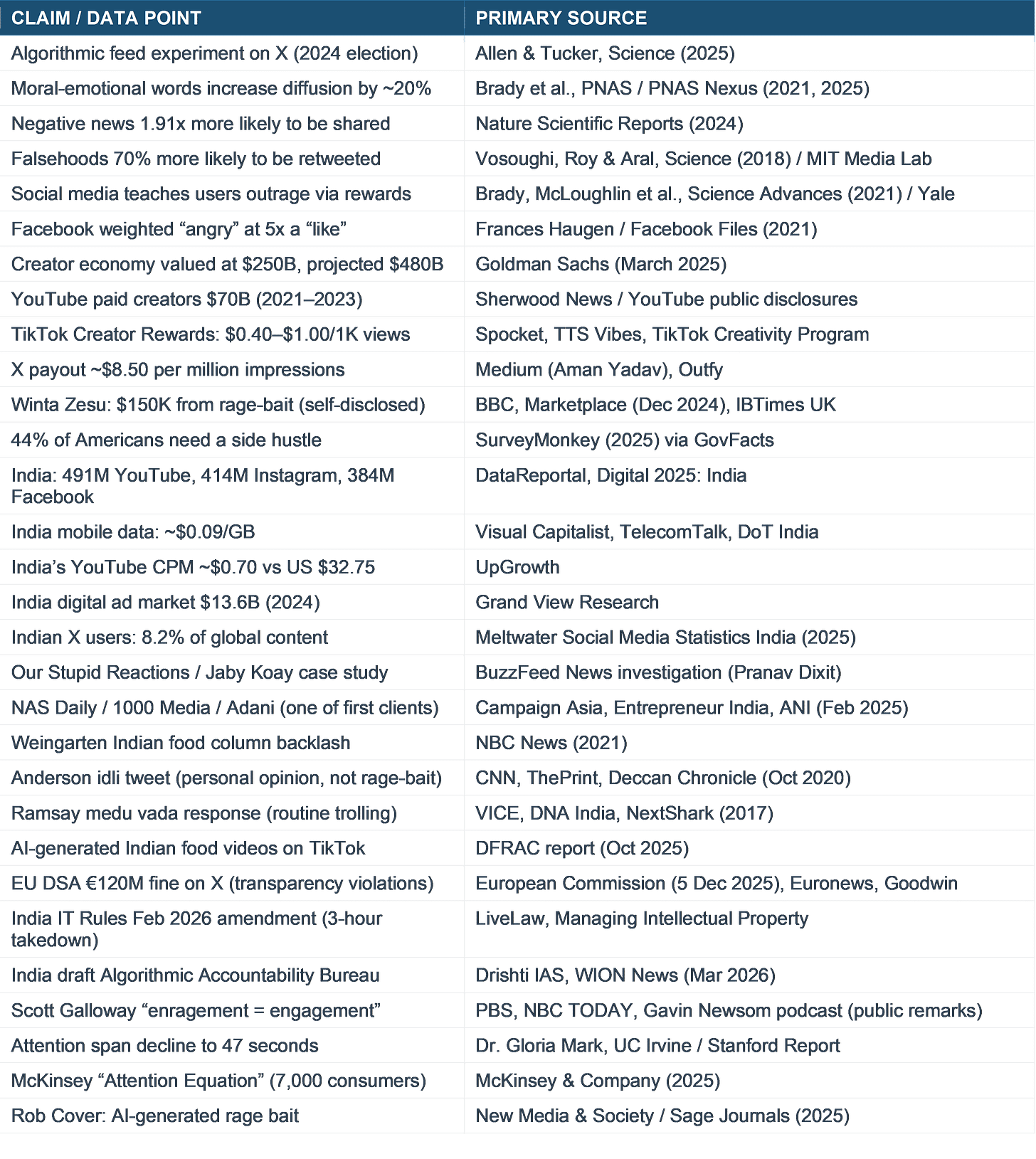
Appendix: Key Sources & Attribution Table
The following table provides key source references for the principal claims, data points, and named individuals cited in this article. All claims are based on publicly available, on-the-record information from the sources indicated.
DISCLAIMER, EDITORIAL STANDARDS & LEGAL NOTES
General Disclaimer
This article is published by Blue Mango Consulting Group (BMCG) for informational and thought-leadership purposes only. It does not constitute legal, financial, or investment advice. The views expressed are those of the author and do not necessarily reflect the views of any organization, platform, or individual cited herein. BMCG is a management consultancy and is not affiliated with, endorsed by, or in any commercial relationship with any of the platforms, companies, creators, or academic institutions referenced in this article.
Regarding Named Individuals & Entities
This article references several public figures, content creators, and organizations. In all cases, the information presented is drawn exclusively from publicly available, on-the-record sources including peer-reviewed academic journals, official government and regulatory documents, established news outlets (BBC, NBC News, CNN, BuzzFeed News, VICE, Marketplace, Campaign Asia, Euronews, ThePrint), and the individuals’ own public statements. Specifically:
• Winta Zesu is cited based on her own voluntary, public disclosures to the BBC and Marketplace regarding her earnings and content strategy. She has publicly described her approach as rage-baiting.
• Edward Anderson (Northumbria University) is cited regarding his widely reported idli tweet of October 2020. This article explicitly notes that Anderson was responding to a Zomato poll, that he is married to a Malayali woman, that he has publicly expressed his love of Indian cuisine, and that his remark was a personal food preference — not deliberate rage-baiting. No accusation of bad faith is made or implied.
• Gordon Ramsay is cited regarding his widely reported social media interaction with a user named Rameez who submitted a photo of medu vada. This article explicitly notes that Ramsay’s response was part of his well-established, general food-trolling persona (applied to all cuisines, not India specifically), that the user who sent the photo did so deliberately and expressed satisfaction with the outcome, and that the outsized reaction was attributable to audience scale and cultural context, not targeted provocation by Ramsay. No accusation of racism, cultural insensitivity, or deliberate anti-Indian intent is made or implied.
• Gene Weingarten is cited in connection with his 2021 Washington Post column, the backlash to which was widely reported by NBC News and other outlets. The Washington Post itself issued a correction and apology.
• NAS Daily (Nuseir Yassin) and 1000 Media are cited based on public reporting by Campaign Asia, Entrepreneur India, ANI, Storyboard18, and Yassin’s own public statements. The Adani Group’s status as “one of the first clients” is reported per Campaign Asia. This article makes no allegation regarding the nature or propriety of this business relationship.
• Our Stupid Reactions (Rick Segall), Jaby Koay, and Dharma Productions are cited based on a BuzzFeed News investigation by Pranav Dixit. All quotes attributed to individuals are drawn from their published statements in that article.
• Scott Galloway is cited based on his public remarks made on PBS, NBC’s TODAY show, the Gavin Newsom podcast, and his own blog/podcast. The formulation used in this article is a close paraphrase of his publicly stated position, not an exact transcript.
• Frances Haugen is referenced in connection with the Facebook internal documents she publicly disclosed before the U.S. Senate in October 2021, which are a matter of public record.
• All academic researchers (Brady, McLoughlin, Crockett, Allen, Tucker, Milli, Vosoughi, Cover, Mark) are cited in connection with their published, peer-reviewed research in Science, Science Advances, PNAS Nexus, Nature Scientific Reports, and New Media & Society.
Regarding Data & Statistics
All statistical claims are sourced from the publications, databases, and reports indicated in the Appendix. Platform-specific data (user counts, CPM rates, creator payouts) are drawn from DataReportal, Meltwater, Grand View Research, UpGrowth, and platform-published information. These figures are subject to change and represent the best available data at the time of writing. BMCG has not independently verified platform-internal data that is not publicly auditable.
The Goldman Sachs creator economy valuation ($250 billion current, $480 billion projected by 2027) is from Goldman Sachs Research (March 2025). The 20–85% engagement premium for negative content represents a range derived from multiple independent studies (Brady et al., Stanford HAI, Nature Scientific Reports), not a single unified dataset.
No Intent to Defame
This article analyses structural and systemic dynamics in the platform economy. It does not accuse any named individual of illegal conduct, moral wrongdoing, or bad faith unless such characterization is based on the individual’s own public self-description (as in the case of Winta Zesu, who has publicly described her strategy as rage-baiting). Where individuals’ actions could be interpreted in multiple ways, this article has endeavoured to present the most charitable reasonable interpretation consistent with the available evidence. BMCG welcomes corrections and will promptly update any factual inaccuracy brought to its attention.
Fair Comment & Analysis
The analytical conclusions drawn in this article — regarding algorithmic incentive structures, the engagement-farm dynamic, and the exploitative relationship between platforms, creators, and audiences — represent the author’s reasoned analysis of publicly available data and peer-reviewed research. They are presented as commentary and analysis on matters of significant public interest and are intended to contribute to informed debate, not to disparage any individual, company, or nation.
Copyright & Reproduction
© 2026 Blue Mango Consulting Group. All rights reserved. This article may be quoted with attribution. For republication or translation rights, contact: bluemangoconsultinggroup.com.
Blue Mango Consulting Group is a full-service management consultancy advising organizations on strategic growth, risk management, and global expansion. This analysis draws on peer-reviewed research, platform data, and industry reports to inform evidence-based decision-making.