

“How Old Are You?” The Answer Used to Be Simple. Its getting complicated now...
**Author’s Note :***Every week my Whoop gives me a new age. You generally tend to ignore what you do not understand, but its difficult if you are a…
**Author’s Note :**Every week my Whoop gives me a new age. You generally tend to ignore what you do not understand, but its difficult if you are a curious person like me. This article is the outcome of the rabbit hole I went down.
_______________________________
Rajiv is 52. His passport says so. So does his insurer, his employer, and his doctor.
The clinic has other ideas. One blood test says 56. Another says 49. His watch thinks his heart looks younger. The clinic’s own composite — blood, body composition, sleep, fitness, metabolic markers — lands at 53.
“How old are you?” the clinician asks.
“Fifty-two.”
“Chronologically, yes. Biologically?”
Rajiv laughs, then stops. He has been one age since his last birthday. He has never been four.
Aisha is 35. A biological-age assessment puts her at 42. She feels fine. She sleeps badly, works late, and has not trained properly since a promotion she still calls temporary. The number bothers her more than any symptom. Six months later, after she has changed her sleep, her training, and the way she ends a day, the score has moved. She does not feel dramatically different. She has a better question: if the number can change, what exactly changed?
That question used to be unaskable. Age was time since birth. It is still the number on the passport. It may not stay the only number institutions believe.
One clock was enough. It isn’t.
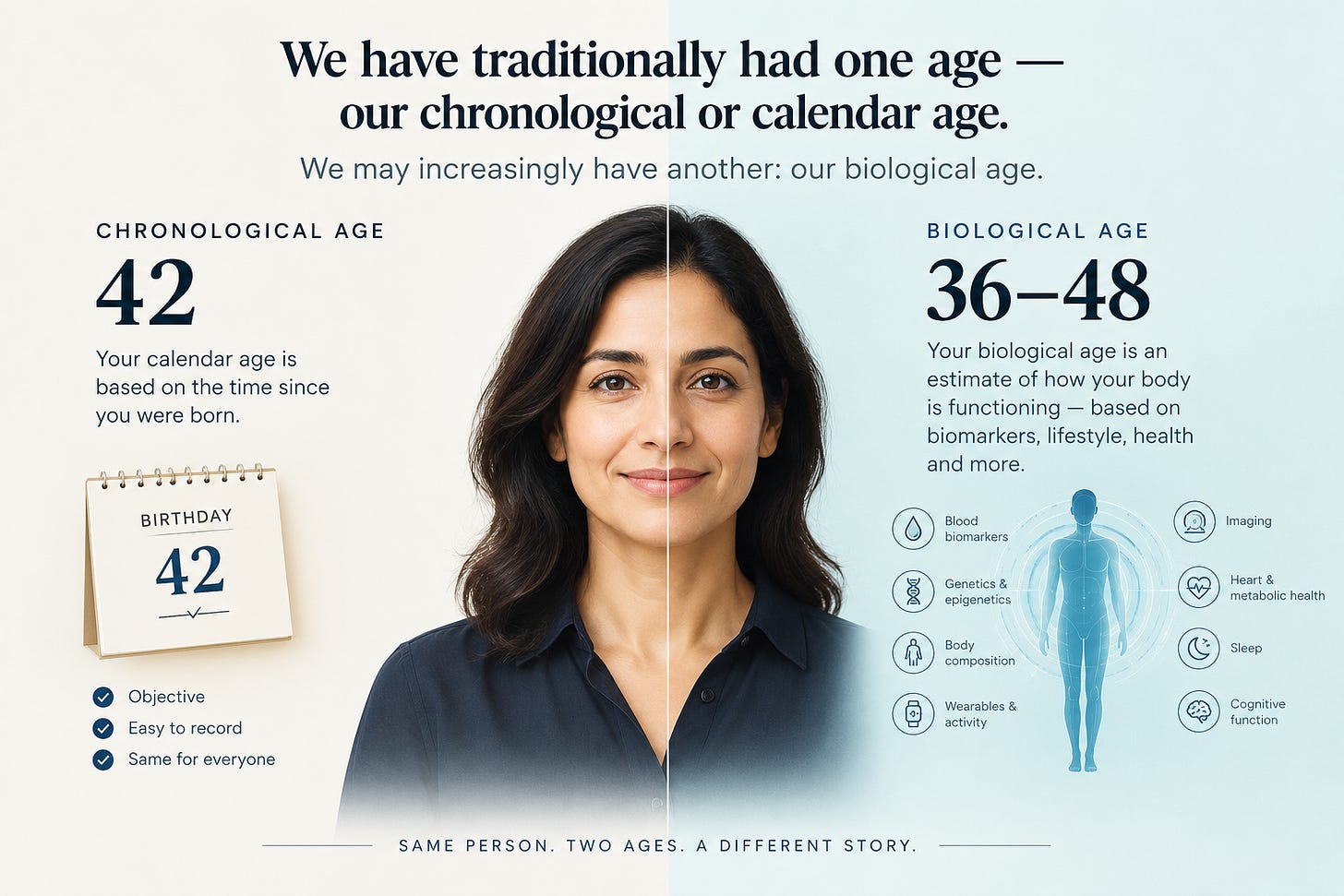
Chronological age measures how long you have existed. Biological age estimates how old or young the body appears to be functioning, relative to that calendar. It is not a second birthday. It is not your true age. It is a model.
The calendar survived because it was crude and objective. Pensions, premiums, retirement ages, and hiring norms were built on it. The body never agreed. Two 50-year-olds can differ sharply in fitness, muscle, metabolic health, inflammation, sleep, and recovery. Society has treated them as 50 and 50.
The model is not settled. Different clocks read different things: chemical tags on DNA, proteins, metabolites, inflammation, organ function, fitness. A 2025 review in Nature Reviews Genetics is plain that epigenetic clocks are powerful and still hard to interpret. Clocks trained on different targets often disagree for the same person. A single reading can be noisy. A clock built on blood is not a clock for every organ. Reviews aimed at clinicians have gone further: these tools can work at population level and still be uninformative, even harmful, if used to make a decision about one individual.
That is Rajiv before lunch. The disagreement is the science, not a glitch.
Wearables add a separate confusion. Watches and rings estimate age-related scores from proxies — pulse, sleep, activity. A 2026 JMIR analysis of the consumer market draws the line: clinical clocks use molecular markers; devices use stand-ins. A wearable does not measure age in any literal sense. Useful as a nudge. Not a diagnosis.
A short prehistory
The wish is old. The instruments are not.
Greek physicians watched function and prescribed balance. The Hippocratic Regimen tied food, exercise, and sleep to age, work, and constitution. Galen described old men kept sound, in his account, by simple food and measured walks. Their metrics were strength, digestion, sleep, mobility, and clarity — not numbers.
Egypt left both a trauma manual, the Edwin Smith Papyrus, and a recipe “for transforming an old man into a youth,” aimed mostly at the skin. Embalming was a technology for the body after death. Today’s project is the opposite: measure change while the person is alive.
Ayurveda went furthest into the lived process, and should be read on its own terms. Jara is growing old. Classical lists name what fails: strength, senses, memory, speech, enthusiasm. Sharngadhara’s decade-wise scheme is almost a dashboard without instruments — lustre, intellect, skin, sight, then strength. Rasayana aimed at longevity and vitality. None of this is a molecular clock. It is structured observation. The continuity is human. The assay is new.
Observation, then philosophy, then the clinic, then the lab, then the sensor, then the model. That is the whole history. The argument starts where the model meets an institution.
The stack does not agree. The market does not care.
Medicine first measured pieces of risk: pressure, cholesterol, glucose, organ function. Molecular biology widened the file — genes, epigenetic marks, proteins, metabolites, the microbiome, imaging. Phones then did what clinics never could. They measured continuously. A visit is a photograph. A watch is a rough film.
Three layers are now sold as if they were one product. Wearables collect proxies. Consumer tests offer occasional depth. Longevity clinics stack labs, scans, and questionnaires. They do not measure the same thing. Until the field agrees what counts, Rajiv will keep collecting ages the way an earlier generation collected opinions.
AI does not invent a new biology. It searches relationships across data no clinician can hold. A doctor with twenty variables is an investor reading twenty companies by hand. The research direction is away from one clock and toward multi-omic models, and toward organs rather than a whole-body average. A 2023 Nature study led by Tony Wyss-Coray used blood proteins to estimate ageing in eleven organs. Nearly a fifth of people over 50 had at least one organ ageing markedly faster. Accelerated heart ageing tracked a much higher risk of heart failure. That is not a pharmacy product. It is proof that one number was always too blunt.
Most of those models were trained on Western cohorts. A model learns the population it is shown. The BHARAT study at the Indian Institute of Science, published in 2026, was built to close that gap: clinical, lifestyle, and multi-omics data, with the aim of Indian signatures and recalibrated clocks. It is a study, not a finished Indian age. India’s older population is projected to pass 347 million by 2050. A clock that misreads that population is not a technical footnote.
Aisha’s 42 and Rajiv’s 53 are estimates from instruments mostly not built on people like them. The scores are already for sale.
The turn
This is not a story about living longer. It is a story about a conversion.
Age becomes data. Data becomes a prediction. Prediction becomes an intervention. Intervention becomes a price.
For centuries, age was accepted. Once a piece of ageing can be measured, monitored, and compared, a market forms around it — whether or not the measure is ready. That is the urgency. Not immortality. Adoption ahead of agreement.
A clinic might one day hand over a page rather than a birthday. Chronological age 47. Composite biological age 43. Cardiovascular 41. Metabolic 46. Musculoskeletal 49. Cognitive 44. Functional 42. Organ clocks exist in research. They are not a clinical standard. The live question is whether health converges on one number, which is easy to sell and easy to misuse, or on a dashboard, which is harder to game and closer to how bodies actually fail.
What changes if the number is trusted
Treat the following as implications, not forecasts. Current clocks do not justify replacing underwriting, hiring, or succession. Munich Re’s 2026 review in the Journal of Insurance Medicine is the right brake: epigenetic clocks add little, for an individual file, beyond age, smoking, pressure, weight, and history. Multi-omic models may matter later. The window is the gap between that brake and the marketing.
Insurance. Two 50-year-olds with different risk profiles are an actuary’s opportunity and a fairness problem. Premiums, prevention discounts, and eligibility are the obvious uses. The near risk is a noisy score dressed up as a better price. Established factors still anchor decisions. Anyone selling a test as an insurance advantage is ahead of the reinsurers.
Work. Candidate A is 55, biological estimate 48. Candidate B is 47, estimate 55. If the measure is reliable, it speaks to capacity. If it is noisy, it is a new way to be wrong with a lab letterhead. Age-discrimination law was written for a calendar. A biological screen could weaken the old bias or replace it with one that is harder to challenge. “Fit for work” shifts from an exam to a trajectory. Employees feel pressure to monitor and disclose. Do not answer this cheaply. Discrimination may not disappear. It may become more sophisticated.
The consumer market. The old line was lose weight, move more. The new line is more confident than the evidence: your trajectory is accelerating; here are three ranked interventions. Around that sentence sit nutrition, training, sleep programmes, supplements, diagnostics, coaching, subscriptions, and clinics. Aisha is the test. The score got her to sleep and train, which is not nothing. It also gave her a number to manage. A moved score is not added years. The changes that move better clocks — exercise, diet, sleep, not smoking — are mostly what a good doctor already said.
Family firms. A founder is 67. The old question is when he steps back. The new one, if measures mature, is functional capacity, cognitive resilience, and trajectory — what work he can still do. Succession shifts from age to capability. Rational, and a governance problem the day the data exist. Who commissions the test? The board, the children, the lender, the key-person insurer? A biological-age report used as a succession document is inside information about a human being.
Money and time. If more people stay capable longer, retirement age, pension maths, career length, and second careers move. Healthier is not the same as longer. Planning on a clock you cannot audit is how a family balance sheet gets fiction in it.
The file. A serious estimate gestures at disease risk, behaviour, and future cost. A bad one gestures at those things and is wrong. Who owns it — the person, the lab, the clinic, the wearable firm, the insurer, the employer, the model? Refusal is a right only if refusal is not punished. If disclosure is the price of a premium, a role, or a loan, consent is a form. The most valuable health data are becoming the most sensitive. Age used to be the one bodily fact that needed no permission.
Ignore it, or align with it
Both are rational. Pretending the market is not forming is not.
Ignore it, for now, if you want to avoid a false precision.
-
Do not treat a watch score as a clinical age. It is a proxy.
-
Do not buy an intervention because one score moved. Ask what outcome the score was trained on. Birthday-trained clocks and mortality-trained clocks do not answer the same question.
-
Do not put a biological-age number in an HR file, an insurance declaration, or a succession note. The measure is not stable enough, and the disclosure cannot be undone.
-
Do not let a clinic sell four ages as one product. If the numbers disagree, that is information about the tools.
-
Wait for standardisation before you reprice anything — a premium, a role, a retirement date.
Align with it, if you want the useful part without the costume.
-
Manage function, not a mascot number. Strength, fitness, blood pressure, glucose, lipids, sleep, and waist are already actionable. They also sit inside the better models.
-
If you test, test the same way twice. Same laboratory, same clock, months apart. Read the direction. Ignore the drama of a single digit.
-
Separate the stack. Wearable for habits. Standard bloodwork for risk. Research clocks, if at all, as a private experiment — not as a fact you hand to a third party.
-
Write the rule before you collect the file. In a firm: who may see a health trajectory, for what decision, with what right of refusal. In a family business: capability conversations without a clock as judge.
-
Use the score, if you use one, the way Aisha should have used hers. As a reason to change sleep, training, and stress. Not as proof that the change bought time.
The cost of ignoring the science is low today. The cost of ignoring the market is not. Products, clinics, and workplace tools are shipping a number the journals still refuse to use on one person. Rules are cheaper to set before a score becomes a condition of a job or a loan.
Which number gets believed
On the way out, Rajiv asks how old he is. The clinician says: which one?
Aisha’s score improved. She still does not know if she changed a risk, a habit, or a model’s mood. Both are the right uncertainty.
On 5 October 2026 the Nobel Prize in Physiology or Medicine went to Karl Deisseroth, Peter Hegemann, and Georg Nagel for optogenetics — light-gated switches for nerve cells, a tool for understanding circuits and, early and carefully, for restoring limited sight. It does not measure age. It marks the other half of the arc: after measurement and prediction comes finer intervention. Fusing the two into one promise is how this gets oversold.
Age was a fact. It is becoming a measurement. If the measurement stabilises, it becomes a management variable — monitored, compared, nudged, priced. The Greeks watched vitality. Ayurveda named what fails by the decade. Medicine learned to measure disease. Sensors started measuring the person without an appointment. Models are now connecting the series, ahead of agreement on what the series means.
When the calendar says 60 and a model says 48, someone will decide which number binds. Before that, someone will decide who may read the page.
If your body gets its own dashboard, who should be allowed to read it — and who should be allowed to act on it?
Disclaimer: Interpret these insights in the context of your own personal/business environment. This is not medical, insurance, employment, or investment advice. Biological-age scores, including consumer wearable estimates, are models, not a clinical diagnosis or a measure of lifespan. AI was used as a research and editorial aid. All opinions, insights, and conclusions are the author’s own.