

Old Monk Never Bought an Ad. It May Need a New Label.
That is not a gossip item. It is a case study. A brand that became the national pour without a single rupee of advertising is now spending its oldest…
On 24 August 2026, India’s rum shelf split in two.
United Spirits walked out of the Bombay High Court. Old Monk’s Khopoli bottler stayed in.
That is not a gossip item. It is a case study. A brand that became the national pour without a single rupee of advertising is now spending its oldest asset — the belief that the bottle is honest — on a fight about what the bottle is allowed to say.
This is the story of how that asset was built, how it was almost spent, how it came back, and what every heritage brand should take from the week that just passed. The laboratory claims are contested. The court has not decided. The management lessons do not need a verdict to be useful.
Love built the monk. Stewardship has to keep him.
A Monday That Split the Shelf
United Spirits, Diageo’s Indian arm, withdrew the writ it had filed on 1 August against FSSAI restrictions on selected spirits. The company said the regulator had, on 17 August, revoked a 29 June order covering a product from its Baramati unit — McDowell’s No. 1 Celebration Matured XXX Rum, on USL’s own description. Engagement with the authority, not a final judgment on the chemistry, is what the exchange language records. Some later reports said label and formulation talks were part of the path back. Those terms are not a published consent decree. What is public is simpler. USL is out of that petition.
Old Monk did not leave with it.
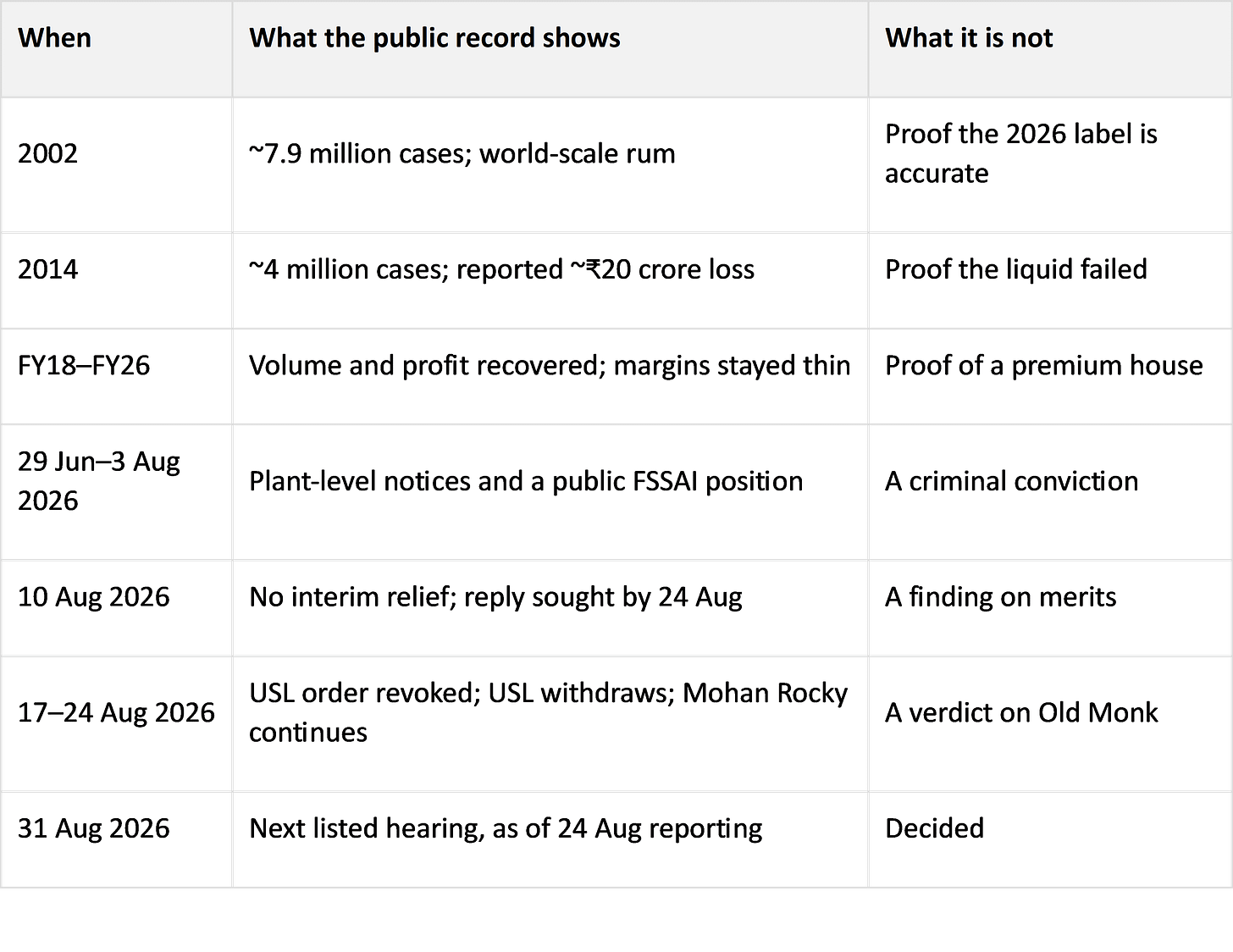
Mohan Rocky Springwater Breweries Pvt Ltd, which bottles three named variants at Khopoli — The Legend, Gold Reserve and XXX Matured Rum — is still challenging a similar prohibition. Mint reported on 24 August that the matter would be heard the following Monday, 31 August 2026. As of today, 26 August, there is no public final order on whether those three SKUs may be sold as “rum,” or must be described as something else.
On 10 August the same bench — Acting Chief Justice Ravindra V. Ghuge and Justice Gautam A. Ankhad — had refused immediate interim relief. The dispute, the court indicated, was statutory compliance, not a poison scare. Senior counsel Navroz H. Seervai, for the manufacturer, told the court the product had been sold for more than five decades, that relabelling would read as a confession that a long practice was wrong, and that the stoppage was costing almost ₹1 crore a day.
Those are submissions. They are not findings.
The live question is not “does India love Old Monk?” It does. The question is narrower. When a regulator says a cult bottle’s name and age line do not match the liquid, does a heritage firm rewrite the pack, reformulate the pour, or ask a court to protect the old words?
How a Monk Became the National Pour
The industrial root is 1855. Edward Abraham Dyer put a brewery in Kasauli so British troops could drink beer “as good as back home.” He was the father of Colonel Reginald Dyer of Jallianwala Bagh. The plant passed through H.G. Meakin, became Dyer Meakin, and after Independence was acquired by Narendra Nath Mohan. It was renamed Mohan Meakin Breweries in 1966 and Mohan Meakin Ltd in 1980. A colonial garrison supplier became an Indian house.
Old Monk itself is a December 1954 creation of Colonel Ved Rattan Mohan, named after Benedictine patience, poured into a squat crackled bottle inspired by Old Parr. After Ved’s death his brother, Brigadier Kapil Mohan — a teetotaler — ran the firm for decades on a rule he would not abandon: quality does not advertise.
The first real distribution system was the armed forces canteen. Hostels, hill stations and newsrooms did the rest. Civilian strength sat at 42.8 percent ABV. The military pour ran hotter. By 2002 the brand was moving about 7.9 million cases, more than double McDowell’s then, and sat among the world’s three largest rums. Canteen stores still account for roughly a tenth of sales in later trade accounts.
People were not buying a campaign. They were buying a feeling that the monk was honest.
That feeling is the asset. It is also the risk.
The Long Sleep, Then the Return
After 1991, India premiumised toward whisky. United Spirits advertised, owned the last mile, and priced Celebration only about 20 percent above Old Monk so the same occasion felt like an upgrade. Mohan Meakin outsourced distribution and treated the 1954 stance as sacred.
Southern excise shocks then erased a large share of volume in a rum category whose real engine is Tamil Nadu and Kerala, not the north Indian winter that made the monk famous. By 2013–14, published reconstructions put Old Monk near 4 million cases against Celebration’s 18.3 million in 2014. Company profit is widely cited as sliding from about ₹2.5 crore in 2005 to a loss of about ₹20 crore in 2014.
Kapil Mohan died in January 2018, at 88. Succession arrived after the monument had already cracked.
Hemant and Vinay Mohan then did the unglamorous work. Availability. Manufacturing discipline. Coffee and spiced XO variants that pulled the brand out of a four-month ritual. IWSR figures reported in late 2025 put 2024 volume at 13 million cases against McDowell’s 9.4 million, with Old Monk up 13.3 percent over five years while USL rum fell 7 percent.
Unlisted-market compilations of Mohan Meakin show a high-volume, thin-margin machine: revenue from about ₹1,099 crore in FY21 to about ₹2,151 crore in FY25 and about ₹2,302 crore in FY26; profit after tax from about ₹40 crore to about ₹103 crore and then about ₹157 crore; debt-to-equity near 0.01. Other published write-ups use slightly different FY24 totals. The direction is not in doubt. Pricing power is.
Love refilled the tank. It did not turn the monk into a high-margin house.
In late July 2026, before the ban headlines, Maharashtra shelves emptied. Trade estimates of national volume still disagree — some desks say 5–6 million cases; IWSR had said 13 million — but the operational fact was a monsoon spike hitting western bottling, including Khopoli. A cult with a few plants is not a fortress. It is a single point of failure.
Then came the regulator.
FSSAI’s public position, set out by the health ministry on 2 August 2026, is that rum’s character is supposed to come from molasses, fermentation, distillation and maturation, and that adding rum flavour to rum is “analogous to the addition of coffee flavour to coffee.” The authority said laboratory work on named units found external flavouring that mimics the drink’s inherent profile, and that such liquids should not be sold as rum unless their true nature is declared.
On Old Monk XXX, the same statement said the “7 years old blended” line was deceptive because, on the regulator’s reading of the 2018 alcoholic-beverage rules, age follows the youngest spirit, and matured rum was alleged to be under 5 percent of that blend. The prohibition named three Khopoli SKUs, not “Old Monk” as a trademark, and sat inside a wider action that also named selected USL and Inbrew products. Two manufacturers, FSSAI said, had already taken a conditional path: disclose true nature on existing stock and stop adding identical flavour in future production.
The manufacturer’s answer in court, as reported, is that the practice is old, the drink has not made people ill, relabelling is a forced confession, and state excise must approve any pack change. The High Court has not ruled on who is right. Mixologists quoted in the press have been harsher than any judge. Their opinions are not laboratory certificates.
What Heritage Brands Should Take From This
Urde, Greyser and Balmer’s heritage test is an audit, not a compliment: track record, longevity, core values, use of symbols, and stewardship. Old Monk has the first four in public abundance. Stewardship is the only element chosen every quarter. That is the element this case is about.
Business. Cult is a residue, not a strategy. Word-of-mouth worked because closed-India distribution, the army canteen, and a cheap honest-feeling bottle did the media job. When the system opened, USL did not beat the monk on romance. It beat him on owned distribution, shelf height, and a slightly dearer price that recoded the same occasion as status. Heritage firms that outsource the last mile lend their trademark to someone else’s priority list. The 2014 collapse is the exhibit. “We do not advertise” is a media choice. It is not a licence to freeze product architecture, geography, or claims.
Revival without a rewrite of the product truth is the second trap. Coffee and XO proved the icon could move. Volume came back. The economic model did not become a maison. Mid-single-digit margins, a related-party trading structure described in market notes, a rum category that crawled from 40 million to 49 million cases in a decade, and a north-and-hill manufacturing map against a south-weighted rum market — these are why a Khopoli order can be described as a crore a day, and why a dispatch snag can empty Maharashtra. A beloved cheap icon is a high-volume hostage unless there is also a smaller, lab-auditable SKU that can carry the oak story without leaning on the mass bottle.
Family governance is the third. A patriarch who will not advertise, will not premiumise, and will not leave on time is not “authenticity.” He is an unpriced key-person risk. Delayed succession turned a distribution problem into a near-death event. Boards of heritage firms should treat label claims the way they treat debt: as commitments that survive the founder.
Manufacturing design is the fourth. FSSAI did not ban an emotion. It named a unit and three SKUs. USL’s relief, on the public filing, was also unit-specific. Multi-plant heritage brands need one product standard, not one myth and many recipes. Franchise and contract bottling without a single compliance spine is how a national icon becomes a local order.
Ethics. “Nobody fell ill” is the wrong test. Toxicity is a hospital question. Labelling is a truth-telling question. The 2018 age rule and the 2020 true-nature-of-food rule were not invented in August 2026. Notices went out in July. Industry consultation was offered. USL engaged and, on 24 August, left the courtroom. Mohan Rocky has chosen to test the order. That is a lawful choice. It is also a stewardship choice, because every extra week teaches the consumer to read the monk as a party in a fight rather than as a bottle that needs no explanation. Fifty years of custom can explain how a practice grew. It cannot, by itself, settle what the 2018 regulation requires. That settlement belongs to the court, not to this essay.
Responsibility to the drinker. The buyer this brand actually has is often a jawan, a student, a monsoon drinker, a reporter off a night shift. He paid a democratic price for an aristocratic sentence: seven years, oak, rum, monk. If a regulator’s lab sheet is right, the harm alleged is not a stomach pump. It is a broken bargain of information. If the manufacturer is right, the harm of a forced relabel is a state rewriting a folk product. Either way, a cult brand carries a higher duty, not a lower one, because its customer scrutinises least. Informed consent fails first at the brands people trust most. Army canteen drinkers, in particular, are not a focus group. They are a captive channel.
There is also a duty to the category. Trade reporting has long described much of IMFL as extra-neutral alcohol dressed as whisky, rum, brandy or vodka. The Print’s August ground report put the same underbelly in plain language, and recalled that the European Union, two decades ago, would not call molasses spirit “whisky.” When the entire shelf is slightly untrue, the honest producer looks expensive and the opaque one looks normal. That is a collective-action trap. The first house that prints a humble, accurate line — spirit drink, or share of matured rum, or youngest-component age — will take a volume hit and may gain the only asset a no-advertising brand actually owns: the right to be believed.
Maggi in 2015 learned that a mother’s brand cannot win a chemistry argument on nostalgia. Cadbury, after the worm scare, changed the pack. Volkswagen’s diesel episode is the global version of “the characteristic taste was engineered.” The opposite craft is Royal Enfield: keep the symbol, rebuild what the customer cannot see. For a liquid, that split is practical. A legally modest everyday SKU with a modest name. A genuinely aged, molasses-led SKU that earns the monk, the oak, and the price.
Heritage is not the mass bottle. Heritage is the claim that can still walk into a laboratory.
Four Doors Still Open
If this were a classroom, the protagonists on 26 August would have four options. None of them is romantic.
A. Legal maximalism. Keep the word “rum.” Keep the seven-year line. Wait for 31 August. Upside: no public rewrite. Downside: USL has already shown the industry another door, and the monk is now the brand still arguing.
B. The path the regulator has already described for others. Declare true nature on stock that exists. Stop identical flavour in future runs. Fight only over-reach. Ugly marketing. Adult stewardship.
C. Architecture. Retire the seven-year sentence on the mass XXX if it cannot be defended on the youngest-spirit rule. Put a small, expensive, auditable oak line on the shelf with molasses share and plant identity a lab can check.
D. Process, not counsel. If flavour is being added because neutral spirit has no character, the repair is more rum spirit and more time. That costs margin. It is also the only repair that matches the 1954 founding story.
The teaching questions are now live, not historical.
When did no-advertising stop being discipline and become neglect?
Who is the customer the firm is responsible to — the drinker who never complained, or the drinker who never had the information required to complain?
Is “industry practice” a defence or an indictment?
What should a family board do when a label claim is also the entire brand?
And after 24 August, what does it mean that the multinational took the regulator’s door while the cult stayed in court?
Old Monk did not go wrong because India stopped loving it. India never did. It went wrong, first, when love was used as working capital to avoid building a modern company — distribution, succession, geography, a second SKU. It is in question now because love is being asked to do a second job: stand in for a settled product truth while a court decides what the bottle may legally say.
Stewardship is not guarding the monk on the glass. It is making sure that what is inside, and what is printed, can survive a laboratory, a statute book, and a consumer who has finally asked what “seven years” was supposed to mean.
The High Court, not this essay, will answer the legal half. The brand still has to answer the rest.
Kirtiraj Gohil is a management consultant and the founder of Blue Mango Consulting Group . This piece is an educational case study for general information. It is not legal advice, not investment advice, and not a finding of fraud, adulteration, illness, or liability. It is not a comment on how the Bombay High Court should decide the pending writ of Mohan Rocky Springwater Breweries Pvt Ltd. FSSAI’s laboratory and labelling statements are allegations and regulatory positions. The manufacturer has disputed the consequences of those positions in court. United Spirits’ separate petition was withdrawn after a later FSSAI order. Figures are taken from published news, IWSR citations in the press, and unlisted-market compilations, which do not always agree. Named individuals are not accused of a crime. Old Monk, Mohan Meakin, Mohan Rocky Springwater, United Spirits, Diageo, Inbrew and related marks belong to their owners; no endorsement is implied. Readers should verify primary filings and use their own judgment before any business decision. Errors will be corrected if shown.