

The iPhone Duo just exposed Apple’s entire lineup.
*A pricing lesson from a country that will buy a ₹1.65 lakh iPhone — and quietly walk past a ₹3 lakh one.*Rahul opened the Apple page the night the…
*A pricing lesson from a country that will buy a ₹1.65 lakh iPhone — and quietly walk past a ₹3 lakh one.*Rahul opened the Apple page the night the Duo launched, saw ₹2,99,900, stared for four seconds, and closed the tab. He did not hate the phone. He already owns an iPhone. He is exactly the kind of urban buyer Apple has spent a decade converting. His brain simply moved the Duo out of the “next phone” folder and into a different drawer: asset, flex, or mistake. That four-second close is not a product review. It is a pricing event. And in India, it did something Apple may not have intended: it forced millions of people to re-read the entire iPhone shelf.
The price that left the category
India’s nominal GDP per capita in 2026 is roughly $2,813 to $3,051 — about ₹2.43 lakh to ₹2.93 lakh at ~₹95.9 to the dollar. The cheapest iPhone Duo costs 1.1× the average Indian’s entire annual income. That is more than a year of average earnings for one device.
Put the same number against lived wages. Regular salaried earnings sit around ₹22,700–₹24,200 a month. The Duo is not “a stretch.” It is a full-year salary for a large share of formal workers, and several years of income for the median earner.
Behavioural science has a blunt name for what happens next. The product drops out of the consideration set. Once a price crosses a mental wall, System 1 stops comparing cameras and chips. It re-labels the object. A ₹1.65 lakh iPhone 18 Pro is still a phone — expensive, aspirational, visible. A ₹3 lakh foldable is a category error: down payment, used-car money, or a very loud decision. Mental accounting moves it from “gadget budget” to “asset budget.” Attention dies not because the product is bad, but because it no longer lives in the aisle people were shopping in. India had already raised that wall. ₹40,000 phones became normal, then ₹80,000, then ₹1 lakh-plus started feeling like serious-but-acceptable premium. The Duo did not climb the wall. It jumped over it.
Who can actually buy it — and why that still isn’t the point
India’s population is about 1.477 billion.
The addressable sliver looks large in absolute terms and tiny as a share:
- Top 1% of all Indians (PLFS-style): roughly ₹21–22 lakh a year — about 14.8 million people .
- Among 8.22 crore ITR filers : 11.5 lakh report income above ₹50 lakh; 3.86 lakh above ₹1 crore.
- High-income households above ₹10 lakh a year: 4.6 crore households , or 13.18% of the population share.
- The top 10% capture 58% of national income . The bottom 50% get 15% .
Apple does not need the average Indian. It never did. India was already its fourth-largest iPhone market: 14 million units in 2025, about 9% volume share and 28–29% value share. In Q2 2026 alone it shipped 3.45 million iPhones here. That is a real premium market — tens of millions of people, larger than many European countries.
The Duo’s problem is not that India is poor. It is that Apple priced a new form factor as if the only buyer left was the ultra-rich, while the people who actually grow Apple’s India business live one or two rungs below that. Those buyers will finance a Pro. They will not casually finance a device that costs almost twice the Pro and ~67% more than Samsung’s latest book-style foldable. In the US the Duo is only about $100 above the Galaxy Z Fold 8. In India the gap is about ₹1.20 lakh. That single market difference is the whole plot.
The Duo made every other iPhone look different
Extreme prices do not only scare people away from one SKU. They rewrite the shelf. This is contrast effect plus compromise effect. Park a ₹2,99,900–₹4,49,900 object at the top of the page and the rest of the lineup suddenly acquires new meaning:
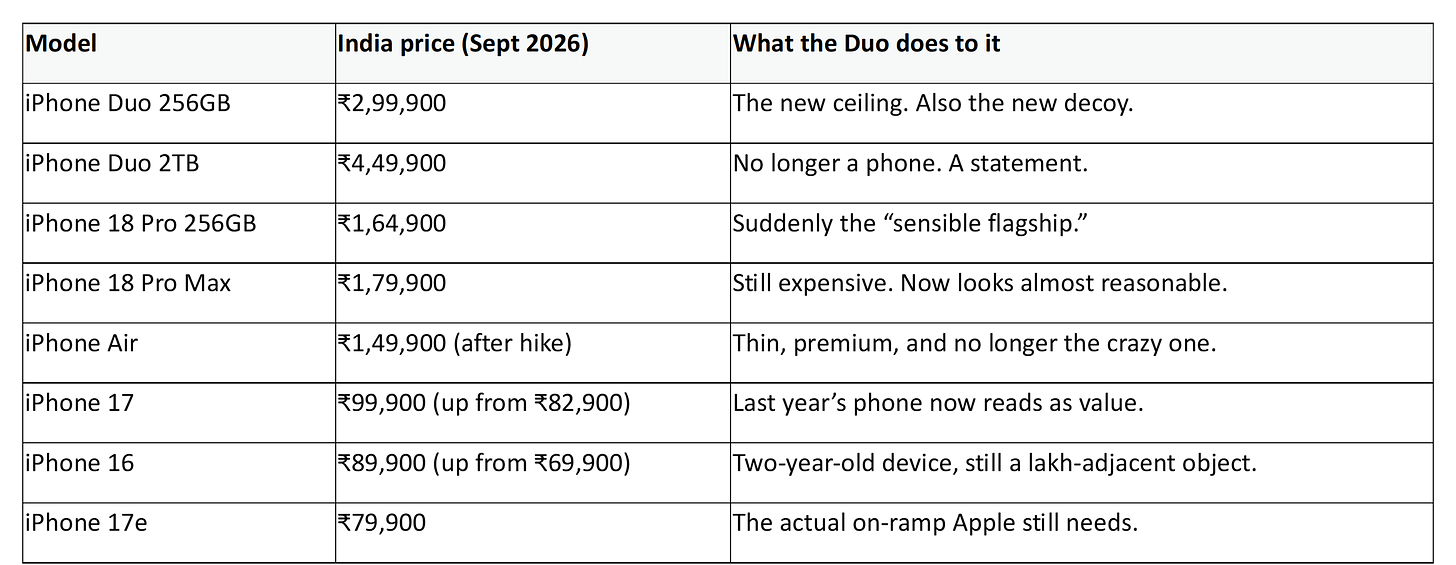
Two more facts make the exposure worse. Apple did not launch a standard iPhone 18. The cheapest new iPhone this September is a Pro at ₹1.65 lakh. And Apple raised prices on the 17, 17e, 16 and Air the same week. So the ladder lost its bottom rung just as the top rung became a foldable priced like a hatchback down payment.
In marketing terms, the Duo became an accidental decoy. Almost nobody has to buy it for it to change choice. It makes the 18 Pro feel like the adult decision, the 17 feel like the clever decision, and the whole “newest iPhone” ritual feel less automatic. That is lineup exposure: one SKU forcing a full audit of every other SKU.
Features versus the life the phone will actually live
On stage the Duo is a 7.6-inch inner Super Retina display, a 5.4-inch outer screen, A20 Pro on 2nm, 12GB RAM, dual 48MP cameras, Duo Preview, Smart Take, Kid Cue, Apple Pencil, dual batteries, and a body that is thin when open. Those are real features.
Construal level theory explains why they underperform in India. From far away — the keynote — the buyer is an abstract future self: family photographer, tablet-in-pocket professional, cinema-on-the-train. Up close the day is dust, monsoon bags, one-handed use in an auto, a child grabbing the phone, UPI, WhatsApp, Reels, and cricket. That is the feature–usage gap. A bigger screen is useful here. India is a video country. Family photo tricks are more relevant than Apple may realise in joint-family homes. eSIM-only is fine in Jio/Airtel/Vi cities and irritating everywhere else. The fold is a liability in pockets and crowded spaces. Most buyers already have a device that does the jobs that fill 90% of Indian phone time. Extra capability used 8% of the time cannot carry a ₹1.2 lakh premium over a Galaxy Z Fold 8 that starts near ₹1.75–1.80 lakh, or a Motorola foldable near ₹1.50 lakh.
The marketing error is selling capability to a market that buys use + signal. When use does not scale with price, the signal has to do all the work. At ₹3 lakh, the signal starts to fail.
Lifespan turns a luxury into a depreciation problemiPhones still win the long game on software. Apple typically supports devices for 5–7+ years. Owners keep them longer: about 61% of iPhone users hold a phone two years or more, versus 41% of Android users. Resale holds up better too. That is why a regular iPhone can be argued as a cost-per-year purchase.
Foldables break that story. People apply a fragility heuristic to hinges and inner screens even before the first crease appears. Anticipatory regret is the tax: “I will feel stupid in year three when the repair quote arrives.” Spread ₹3 lakh across four good years and you are still paying luxury-per-year money for an object that lives in a pocket. Loss aversion is stronger when the item is both expensive and mechanically riskier than a slab. The rationalisation that works for an 18 Pro — “I’ll use it for five years” — does not transfer cleanly to a first-generation foldable.
When the boast reverses
A ₹1.65 lakh Pro still works as conspicuous consumption in India. It is visible. It is understood. It says I can.A ₹3 lakh foldable starts saying I have more money than judgment.This is the inversion of the Veblen effect. Status signalling has a ceiling in a collectivist market. Log kya kahenge does not only push people to buy the logo. Past a point it punishes the purchase. Friends do not think “he arrived.” They think “he is performing.” Memes about selling a kidney and street snatches attached themselves to the Duo within hours. That is not desire. That is social punishment for overshooting the acceptable flex.
Indian consumers will pay a premium for visible consumption. An iPhone in a café still works. A foldable that costs as much as a small car starts looking like conspicuous foolishness rather than conspicuous success. The boast effect does not disappear. It flips.
The competitive hole Apple opened
Satisficing beat maximising. Once a “good enough” book-style foldable exists at a price that still feels premium, the Duo has to win on ecosystem religion or pure status. For most buyers it wins on neither strongly enough. The reference price is no longer “other iPhones.” It is “other foldables that do the same party trick for ₹1 lakh less.” That is a pricing own-goal. Apple entered a category Samsung has educated for years, then set an India premium so wide that the competitor looks disciplined instead of cheap. The Duo did not just fail to pull the category up. It made Android foldables look like the intelligent luxury choice.
The lesson
Apple’s India success was built on a ladder: a recognisable logo, a stretch price that still felt like a phone, EMI that converted aspiration into volume, and a lineup that let people enter, upgrade, and signal without looking reckless. Fourteen million iPhones in a year is the proof. The Duo kicked the top of that ladder into a different market — ultra-luxury gadgets — while the company simultaneously removed the standard new iPhone and raised prices on the rungs people actually climb. The marketing lesson is not “don’t be premium.” India has already accepted ₹1 lakh phones. The lesson is:
- Every market has a consideration-set wall. Cross it and you are no longer selling a better phone. You are selling a different product category with a much smaller jury.
- A hero SKU re-prices the whole line. If the halo is too far from the body, it does not lift the body. It audits it. People start asking whether the 18 Pro, the 17, or last year’s phone is the real buy.
- Status is not linear with price. In India it rises, then it snaps. Visible premium works. Visible excess gets mocked.
- Feature stories lose to usage stories. Family photography and a bigger screen are relevant. They are not ₹1.2 lakh more relevant than a Fold 8.
- Price gaps versus local rivals matter more than price gaps versus your own US list. $100 in America became ₹1.2 lakh in India. That is not tax. That is positioning.
The Duo can still sell to the thin slice that collects objects, lives inside Apple’s ecosystem, and does not need the purchase to make social sense. That is a valid business. It is not the business that made India Apple’s fourth-largest iPhone market. Rahul will watch the unboxing. He may even go to the store in October and open the hinge. Then he will buy the phone that still sits inside the category his friends, his EMI limit, and his self-image can defend. That is not India rejecting Apple. That is India showing Apple where the lineup actually ends.
Disclosure: We use AI as a research, validation, and editorial support tool. The central argument, hypotheses, insights, and conclusions presented here are our own and reflect the author’s independent thinking.