

Liberalised Remittance Scheme (LRS): A Comprehensive Guidebook for Indian Citizens
Understand LRS and open the new avenues of opportunities . www.bluemangoconsultinggroup.com
Executive Summary
The Liberalised Remittance Scheme represents one of India’s most progressive foreign exchange policies, enabling resident individuals to participate in the global economy with remarkable ease. Introduced by the Reserve Bank of India in 2004, LRS allows Indian residents to remit up to USD 250,000 per financial year for a wide range of permissible purposes, from education and healthcare to overseas investments and property acquisition. This guidebook provides a systematic understanding of LRS—its mechanics, benefits, limitations, and practical implementation—tailored for both seasoned investors and first-time users.
What is the Liberalised Remittance Scheme?
The Liberalised Remittance Scheme is a facility provided by the Reserve Bank of India under the Foreign Exchange Management Act (FEMA), 1999, that permits resident individuals to freely remit foreign exchange abroad without requiring prior RBI approval. The scheme represents India’s commitment to financial liberalization while maintaining prudent capital account management.
Key Parameters:
- Annual Limit: USD 250,000 per financial year (April–March)
- Scope: Both current account and capital account transactions
- Reset Mechanism: The limit resets annually; unused portions cannot be carried forward
- Frequency: Unlimited number of transactions permitted within the annual ceiling
The scheme evolved from an initial limit of USD 25,000 in 2004 to its current threshold, reflecting India’s growing economic confidence and integration with global markets.
Who Can Use LRS?
Eligible Participants:
The scheme is exclusively available to resident individuals as defined under FEMA, 1999. This includes:
- Adult Indian citizens residing in India
- Minors (through their natural guardian or legal representative)
- Individuals of any nationality who qualify as residents under FEMA definitions
Critical Exclusions:
The following entities are not eligible for LRS:
- Corporations and companies
- Partnership firms
- Hindu Undivided Families (HUFs)
- Trusts and charitable organizations
- Non-Resident Indians (NRIs)
Important Note: NRIs have separate remittance regulations, with the ability to remit up to USD 1 million annually from NRO accounts, and unlimited remittances from NRE/FCNR accounts.
Permissible Transactions Under LRS
The scheme permits an extensive range of legitimate transactions, broadly categorized into current account and capital account activities.
Current Account Transactions:
These relate to day-to-day international financial activities:
- International Travel: Tourism, business trips, conferences (excluding Nepal and Bhutan)
- Education Abroad: Tuition fees, accommodation, living expenses, examination fees
- Medical Treatment: Healthcare costs, hospitalization, accompanying attendants
- Employment Expenses: Relocation costs, visa fees for overseas employment
- Family Support: Maintenance of close relatives residing abroad
- Emigration: Costs associated with permanent relocation
Capital Account Transactions:
These involve investments and asset acquisitions abroad:
- Foreign Bank Accounts: Opening and maintaining foreign currency accounts
- Overseas Investments: Equity shares, debt instruments, mutual funds, ETFs, bonds
- Real Estate: Purchase of residential or commercial property overseas
- Business Ventures: Setting up wholly-owned subsidiaries or joint ventures abroad
- Loans to NRIs: Extending INR-denominated loans to non-resident relatives
Prohibited Transactions:
The RBI explicitly prohibits certain activities to protect national economic interests:
- Lottery tickets, sweepstakes, gambling, betting
- Margin trading on overseas exchanges or forex speculation
- Trading in Transferable Development Rights (TDRs)
- Investments in entities involved in agricultural/plantation activities or real estate trading (with specific exceptions)
- Transactions with countries identified by FATF as non-cooperative jurisdictions
- Remittances to entities identified as terrorism risks by RBI
- Gift remittances between two Indian residents in foreign currency
Tax Collected at Source (TCS) Framework
Understanding TCS is crucial for effective LRS utilization, as it impacts cash flow and tax planning.
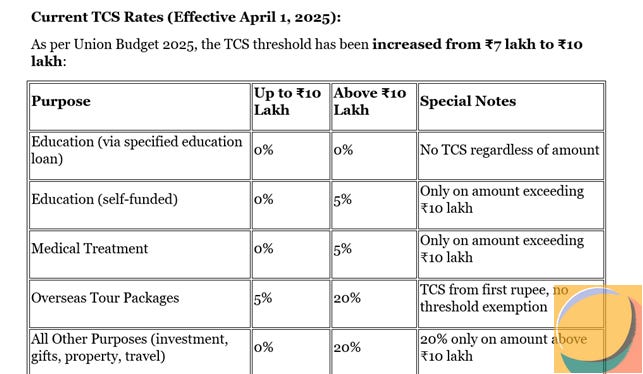
Current TCS Rates (Effective April 1, 2025):
See picture Attached
As per Union Budget 2025, the TCS threshold has been increased from ₹7 lakh to ₹10 lakh:
Key Considerations:
- TCS is not an additional tax ; it can be claimed as credit when filing Income Tax Returns (ITR)
- The amount can be adjusted against total tax liability or claimed as a refund
- TCS is tracked via Form 26AS, accessible through the Income Tax portal
- If PAN is not provided or is inoperative, higher TCS rates apply (10% or 20% depending on the transaction)
How to Use LRS: Step-by-Step Process for Beginners
Implementing an LRS transaction is straightforward when you understand the procedural requirements.
Step 1: Verify Eligibility and Documentation
Ensure you have the following documents ready:
- Valid Passport (mandatory for all LRS transactions)
- PAN Card (absolutely mandatory; no LRS transaction possible without PAN)
- Proof of Address (Aadhaar card, voter ID, utility bills, driving license)
- Active Bank Account with an Authorized Dealer (AD) bank in India
Step 2: Determine Purpose and Required Documentation
Based on your remittance purpose, gather additional supporting documents:
For Education:
- Admission letter or enrollment confirmation
- Fee invoice or payment schedule from the institution
- Student’s passport
For Medical Treatment:
- Hospital estimate or admission letter
- Doctor’s certificate or medical report
- Patient’s passport and visa
For Property Purchase:
- Property purchase agreement or offer letter
- Valuation report from the foreign country
- Proof of overseas bank account (if applicable)
For Investments:
- Brokerage account opening documents
- Investment declaration forms
Step 3: Approach Your Authorized Dealer (AD) Bank
Most commercial banks in India are authorized dealers. Many banks offer both branch-based and online LRS services:
- HDFC Bank: RemitNow portal
- ICICI Bank: Money2World platform
- Axis Bank, SBI, DBS: Online portals and branch services
Online Process:
- Log into your bank’s net banking platform
- Navigate to the Forex/Remittance section
- Select LRS/Foreign Remittance option
- Fill in beneficiary details and purpose code
- Upload required documents
- Complete payment and TCS compliance
Branch Process:
- Visit your bank branch with all documents
- Request LRS transaction assistance
- Complete Form A2 (application and declaration)
- Provide purpose of remittance with supporting documents
- Make payment via demand draft, wire transfer, NEFT/RTGS
Step 4: Complete Form A2 (Application cum Declaration)
Form A2 is the cornerstone document for all LRS transactions. It serves dual purposes:
- Application for foreign exchange purchase
- Declaration confirming compliance with LRS limits and regulations
Key Sections of Form A2:
Section I: Personal details (name, address, PAN, passport, bank account) Section II: Foreign exchange requirement (amount, currency, purpose code) Section III: Beneficiary details (name, address, bank details, country) Section IV: Mode of remittance (direct remittance, demand draft, forex card) Section V: Declaration of previous LRS remittances in the financial year
Purpose Codes: The RBI has designated specific codes for different remittance purposes. Common codes include:
- S0201: Private visit/Tourism
- S0301: Medical treatment
- S0401: Studies abroad
- S1301: Maintenance of close relatives
- S1401: Investment in equity capital
- S1402: Investment in debt securities
Step 5: Tax Compliance (Form 15CA and 15CB)
For certain remittances, particularly those involving payments to non-residents or foreign entities, additional tax forms are required:
Form 15CA: An online declaration submitted to the Income Tax Department confirming tax deduction compliance
Form 15CB: A certificate from a Chartered Accountant verifying that applicable taxes have been paid
When Forms Are Required:
- Form 15CA: Mandatory for most remittances above certain thresholds
- Form 15CB: Required when remittance exceeds ₹5 lakh and is taxable in India
Exemptions:
- Personal remittances under LRS for education, travel, medical treatment (within RBI limits)
- Remittances where the payment is not chargeable to tax in India
Step 6: Processing and Tracking
Once submitted:
- Bank verifies documentation and LRS limit availability
- TCS is collected (if applicable)
- Foreign exchange is purchased at prevailing rates
- Funds are transferred to beneficiary account
- You receive confirmation and transaction receipt
Timeline: Most LRS transactions are processed within 1-3 business days for online remittances, 3-5 days for branch transactions.
Advantages of LRS
From a wealth management perspective, LRS offers significant strategic benefits:
1. Financial Flexibility and Autonomy
The scheme grants individuals unprecedented freedom to manage international financial commitments without bureaucratic hurdles. The USD 250,000 annual limit is sufficient for most personal needs—covering education costs, medical emergencies, family support, and meaningful investment diversification.
2. Global Investment Diversification
LRS enables Indian investors to access international equity and debt markets, reducing concentration risk in domestic markets. Investors can purchase:
- Foreign stocks listed on NYSE, NASDAQ, LSE, etc.
- International mutual funds and ETFs
- Foreign bonds and fixed-income securities
This diversification can provide:
- Currency hedging benefits
- Exposure to global growth sectors (technology, healthcare)
- Access to markets with different economic cycles
3. Simplified Process Without Prior RBI Approval
Unlike previous regimes requiring case-by-case RBI permission, LRS operates on a self-declaration basis, significantly reducing processing time and administrative burden. This streamlined approach encourages legitimate international financial activities.
4. Support for Education and Healthcare
The scheme facilitates access to world-class education and medical care abroad, with favorable TCS treatment. Especially beneficial for students, education-related remittances through education loans now attract zero TCS.
5. Estate and Legacy Planning
LRS permits strategic wealth positioning through:
- Purchase of overseas property for residency or investment
- Setting up family offices or holding structures abroad
- Facilitating emigration or obtaining golden visas
6. Forex Card and Travel Convenience
Funds remitted under LRS can be loaded onto forex cards, providing locked-in exchange rates and protection from currency volatility during travel.
Disadvantages and Challenges of LRS
A balanced Goldman Sachs-style analysis requires acknowledging the scheme’s limitations:
1. Annual Ceiling Constraint
The USD 250,000 limit, while generous for most personal needs, can be restrictive for:
- High-value property purchases (especially in markets like US, UK, Dubai)
- Substantial overseas business investments
- Comprehensive portfolio diversification strategies
Workaround: Family members can pool their individual LRS limits for joint property purchases or investments, provided all members are co-owners.
2. High TCS Impact on Cash Flow
The 20% TCS on non-essential remittances above ₹10 lakh creates significant upfront cash flow constraints:
- For a USD 50,000 (₹42 lakh) investment, approximately ₹6.4 lakh is collected as TCS
- While reclaimable, the funds remain blocked until ITR filing and processing
- Creates opportunity cost of capital for 6-12 months
Mitigation Strategy: Plan remittances strategically across financial years, maximize the ₹10 lakh threshold, and ensure timely ITR filing for quick refunds.
3. Currency Exchange Rate Volatility
LRS transactions are subject to prevailing exchange rates at the time of remittance. Rupee depreciation against the dollar can erode purchasing power:
- A 5% rupee depreciation effectively reduces your USD 250,000 limit by USD 12,500
- Timing of remittances becomes critical for cost optimization
Best Practice: Consider forex forward contracts or remit when rupee is stronger.
4. Complex Documentation and Compliance
While more liberal than previous regimes, LRS still requires substantial documentation:
- Form A2 with accurate purpose codes
- Supporting documents for each transaction type
- Potential Form 15CA/15CB requirements
- Annual tracking of cumulative remittances
Common Pitfall: Incorrect purpose coding or incomplete documentation can lead to transaction rejection or delays.
5. Prohibited Transaction Restrictions
The extensive list of prohibited activities limits certain investment strategies:
- No margin trading or derivatives speculation
- Restricted real estate investments (no TDRs, agricultural land)
- No investments in certain high-risk jurisdictions
6. Tax Complexity for Returns
Income generated from LRS investments (dividends, capital gains, rental income) faces dual taxation considerations:
- Taxation in the foreign country where income is earned
- Additional taxation in India (with credit for foreign taxes paid under DTAA)
- Requires maintenance of detailed records and potentially complex tax filings
7. No Reversal of Repatriated Funds
If funds are brought back to India within the same financial year, they cannot be re-remitted under LRS if you’ve already exhausted your annual limit. This lack of flexibility can be problematic for trial investments.
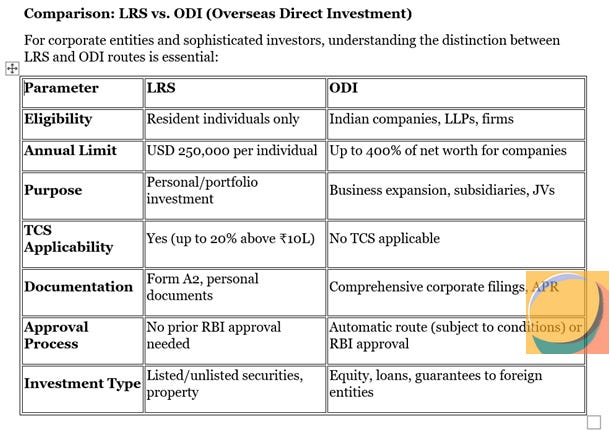
Comparison: LRS vs. ODI (Overseas Direct Investment)
For corporate entities and sophisticated investors, understanding the distinction between LRS and ODI routes is essential:
See picture Attached
Strategic Insight: High-net-worth individuals making substantial business-oriented investments may benefit from structuring through corporate ODI routes to avoid TCS and access higher limits.
Common Mistakes to Avoid
1. Exceeding the Annual Limit
Breaching the USD 250,000 threshold results in transaction rejection and potential FEMA violations. Banks are required to verify cumulative remittances before processing.
Best Practice: Maintain a personal tracker of all LRS transactions throughout the financial year.
2. Incorrect Purpose Declaration
Misreporting the purpose of remittance (e.g., declaring investment as travel to avoid higher TCS) constitutes a serious compliance violation:
- Can lead to penalties under FEMA
- May result in blocked future LRS access
- Creates complications for legitimate expense claims
3. Ignoring TCS Planning
Failing to account for TCS impact in financial planning can create cash flow stress. Remember: TCS is collected upfront but refunded only after ITR assessment.
4. Inadequate Documentation
Incomplete or incorrect supporting documents lead to transaction delays or rejections:
- Ensure all documents are current and clearly legible
- Translations may be required for foreign-language documents
- Keep copies of all submitted documentation for tax filing
5. Not Declaring Previous Remittances
Form A2 requires accurate declaration of all prior LRS remittances in the financial year. Failure to disclose can result in inadvertent limit breaches.
6. Using Informal Channels
Attempting to bypass LRS through hawala or other informal mechanisms to avoid limits or TCS is illegal and carries severe penalties under FEMA and Prevention of Money Laundering Act.
Strategic Use Cases: Wealth Manager’s Perspective
Case 1: Funding Overseas Education
Scenario: Parents need to send ₹40 lakhs (USD 48,000) annually for their child’s US university education.
Optimal Approach:
- First ₹10 lakhs: Zero TCS
- Remaining ₹30 lakhs: 5% TCS (₹1.5 lakhs collected)
- If education loan taken: Zero TCS on entire amount
- Use purpose code S0401 for education
- Remit fees directly to university to establish clear trail
Tax Strategy: Claim TCS credit when filing ITR; education loan interest eligible for Section 80E deduction.
Case 2: Diversified International Investment Portfolio
Scenario: Investor wants to allocate USD 100,000 to US equities and USD 50,000 to global bonds.
Implementation:
- Open international brokerage account (Charles Schwab, Interactive Brokers)
- First ₹10 lakhs remitted: Zero TCS
- Remaining amount: 20% TCS applies (refundable)
- Use purpose codes S1401 (equity) and S1402 (debt)
- Maintain detailed records for capital gains taxation
Tax Planning: Long-term capital gains (>24 months) taxed at 20% with indexation benefit; short-term gains taxed as per slab.
Case 3: Dubai Property Purchase
Scenario: Family wants to purchase property in Dubai worth USD 400,000 for golden visa eligibility.
Strategy:
- Pool LRS limits: Two family members each remit USD 200,000
- Property must be purchased jointly in both names
- Year 1: First member remits USD 200,000
- Year 2: Second member remits USD 200,000
- Both listed as co-owners on title deed
Compliance: No prior RBI approval needed for residential/commercial property; maintain Dubai Land Department registration documents.
Future Outlook and Regulatory Trends
Recent regulatory movements indicate RBI’s evolving stance on capital account liberalization:
Tightening of FD Deposit Rules
RBI is considering amendments to prohibit using LRS funds for fixed deposits with lock-in periods abroad, viewing this as “passive wealth shifting”. This reflects concerns about:
- Growing outward remittances (USD 29.56 billion in FY2025)
- Capital account convertibility caution
- Desire to prevent remittances beyond genuine productive purposes
Enhanced Monitoring
Banks are implementing more robust tracking systems to prevent LRS limit breaches across multiple banks. Centralized reporting may be introduced for better oversight.
Potential Limit Revisions
Given India’s strengthening external position, the LRS limit may be increased in future, continuing the historical trend from USD 25,000 (2004) to USD 250,000 (2015).
Conclusion: Making LRS Work for You
The Liberalised Remittance Scheme represents a powerful tool for Indian residents to engage with the global economy—whether for education, healthcare, investment, or lifestyle purposes. Success with LRS requires:
- Clear Understanding: Know eligibility, limits, and permitted/prohibited transactions
- Strategic Planning: Time remittances to optimize TCS impact and exchange rates
- Meticulous Documentation: Maintain comprehensive records for compliance and tax purposes
- Professional Guidance: Consult tax advisors and wealth managers for complex transactions
- Disciplined Tracking: Monitor cumulative remittances throughout the financial year
For layman beginners, start with smaller, straightforward transactions (travel, education payments) to familiarize yourself with the process before undertaking complex capital account investments. For sophisticated investors, LRS can be integrated into comprehensive wealth management strategies encompassing global diversification, tax optimization, and legacy planning.
The scheme embodies India’s journey toward greater financial openness while maintaining prudent capital controls—a balance that serves the interests of both individual prosperity and national economic stability.
Disclaimer: This guidebook is for informational purposes only and does not constitute financial, legal, or tax advice. LRS regulations are subject to change; always verify current RBI guidelines and consult qualified professionals before making remittance decisions. Writer owns a company which helps people settle abroad including residence by investment , invest abroad or buy foreign businesses.
References: All information is sourced from RBI circulars, FEMA regulations, Income Tax Act provisions, and authorized financial institutions as cited throughout this document[1-108]
www.bluemangoconsultinggroup.com
.